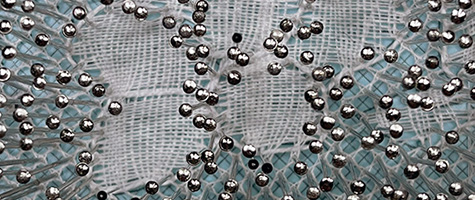
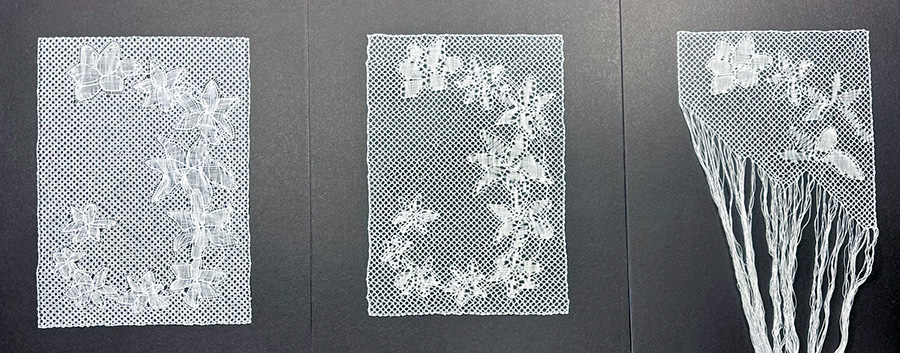
Reality is the final lacework in Idealism, a three-part series that moves from the illusion of perfection to instability and, finally, fragmentation. Utopia established the original floral design in Flanders lace, while Disillusion recreated it in Torchon with subtle glitches and intentional problems.
For Reality, I wanted to see how far I could break the rules while still making a recognizable and relatively beautiful piece of lace. Surprisingly, it was one of the most fun pieces in the series to design and make.
Starting with a Perfect Flower
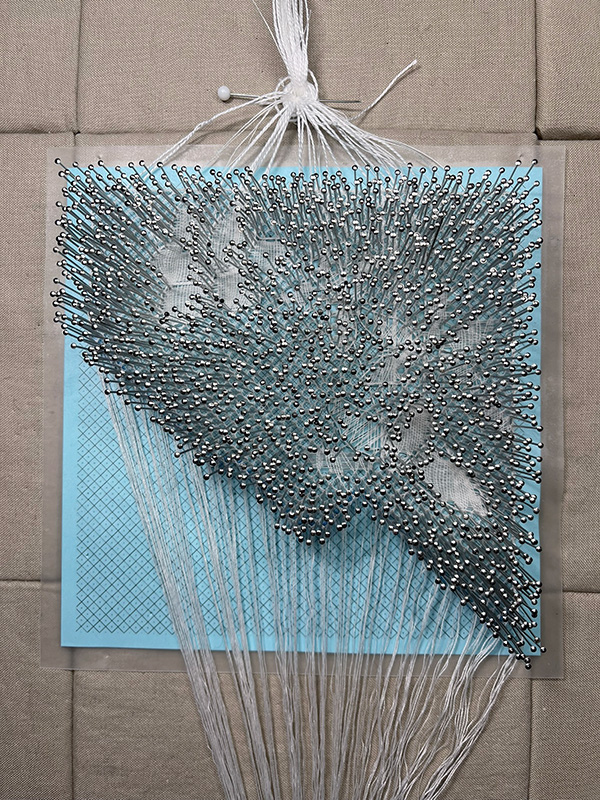
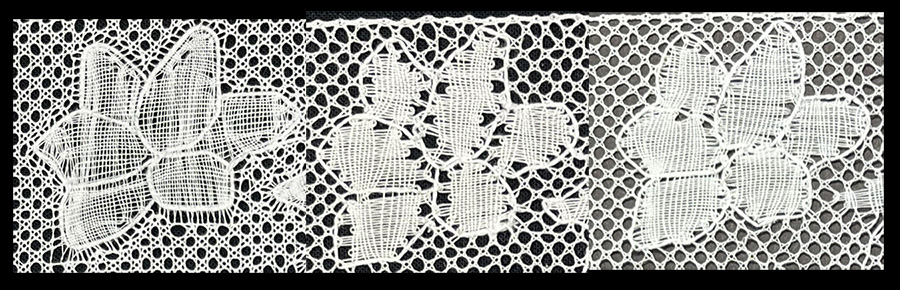
I used the Disillusion Torchon pattern as my starting point and began changing it. Before I could start breaking everything apart, though, there was one thing I wanted to prove. The cloth stitch flowers in Disillusion deliberately don’t fill their outlines correctly. I started worrying that someone might look at them and think I simply didn’t know how to make the flowers properly. Somehow forgetting Utopia existed? So, I made the first flower in Reality correctly.
I extended every pinhole to the gimp and added extra passive pairs as I worked to give the petals a full, dense appearance. Comparing that flower with the same one in Utopia was fascinating. Torchon can create beautifully dense cloth stitch, but it doesn’t look quite the same as the Flanders close work. Flanders uses more, finer threads, giving the petals an almost gradient appearance. The Torchon threads are more visually distinct. Both versions work and show how differently two types of lace can interpret the exact same flower.
Breaking the Rules
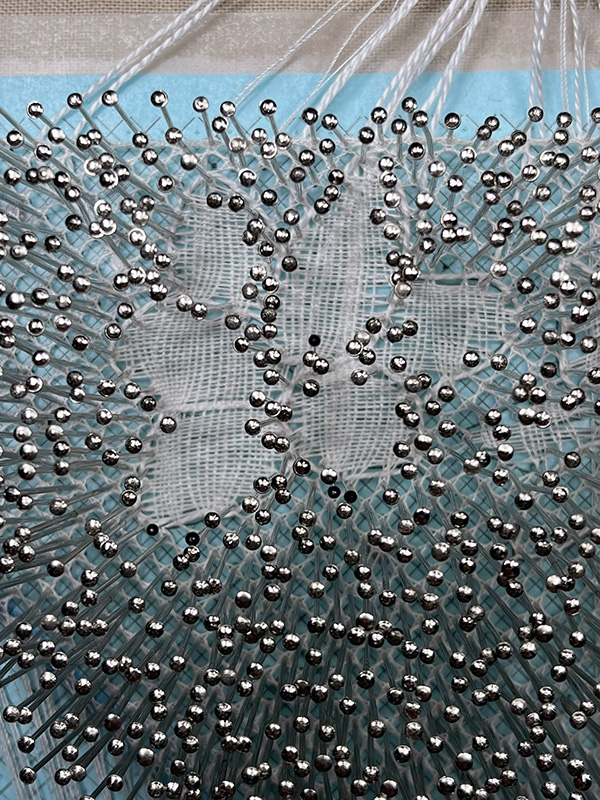
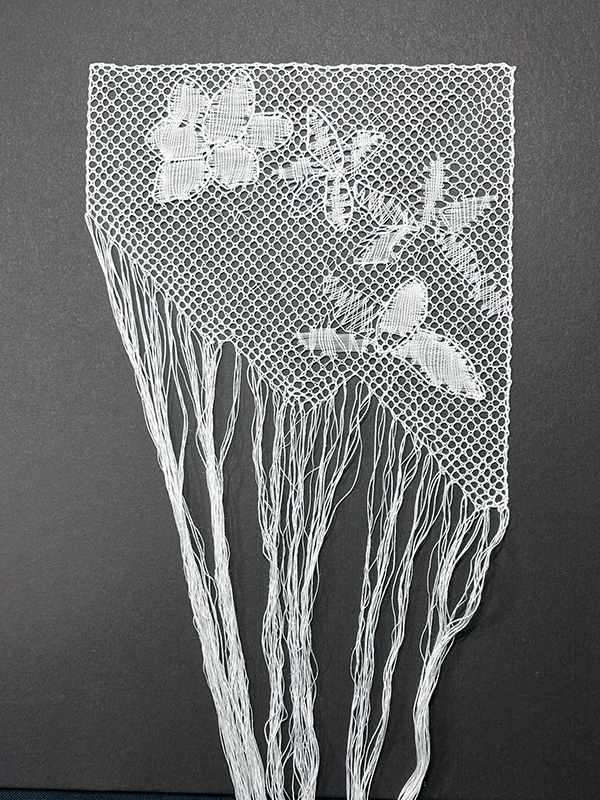
Once I proved that I could make the flower correctly, I started having fun making everything else wrong. I designed most of the “problems” directly into the Reality pattern. Some flowers are missing petals. Some have no gimp, while others use the too-thin gimp I rejected while sampling Utopia. In one flower, the gimp creates the outline of a petal, but I filled the inside with ground instead of a cloth stitch trail. Another cloth stitch trail continues beyond the point where its gimp ends and runs toward the edge of the lace.
I also scattered incorrect stitches throughout the Torchon ground. For those, I randomly selected a different stitch and worked it into the ground where it didn’t belong. Everything still functions as lace. It just isn’t following the rules anymore.
Mixing Utopia and Disillusion
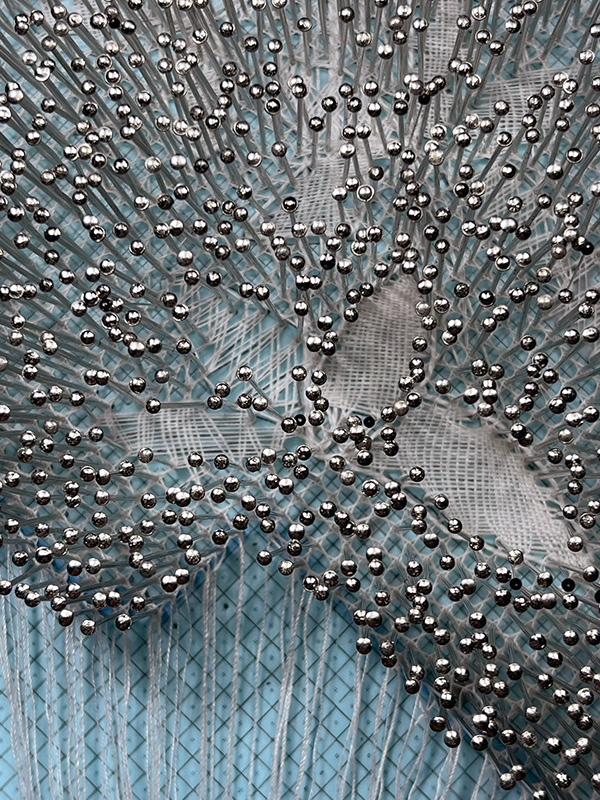
Reality uses the same 148 bobbins as Disillusion, but this time I combined the materials from the first two pieces. I wound some pairs with the Fil au Chinois cotton used in Utopia and others with the Gutermann silk from Disillusion. I intentionally wound an uneven number of each and then hung the pairs randomly across the top of the pattern.
The cotton and silk are different sizes and textures, creating a subtle imbalance throughout the lace. I didn’t plan where either thread would end up. Once the bobbins were on the pillow, I simply let them travel through the pattern wherever the lace took them.
Letting Go of the Rules
I normally love logical, symmetrical lace, so I was surprised by how freeing it felt to purposefully break the rules. Designing Reality was kind of a game. I kept asking myself what else I could do to make the lace wrong while still keeping it relatively pretty. Missing petals, incorrect stitches, the wrong gimp, missing gimp, cloth stitch where it shouldn’t be, ground where cloth stitch should be. Things I would normally consider errors became part of the design.
There was an important limit. I still wanted someone to look at Reality and immediately recognize the original Utopia pattern. The design could break apart, but it couldn’t become unrecognizable.
Leaving the Lace Unfinished
Eventually, Reality stops completely. Rather than finishing the rectangular pattern like Utopia and Disillusion, I designed a jagged edge where different sections of the lace end at different points. As I reached those areas, I tied off the pairs and left the remaining threads hanging.
Once the lace was finished, I unwound the bobbins and left all those threads attached. I tied the ends together temporarily so they wouldn’t become hopelessly tangled before I was ready to use them as part of the finished artwork.
Reality
There is an important difference between the imperfections in Utopia and the mistakes in Reality. The small imperfections in Utopia happened because I am human. They weren’t intentional, and as a lacemaker, those little errors can be heartbreaking. Every mistake in Reality was a choice. Instead of being ashamed of them, I was proud of them.
In Reality, the lace is still recognizable. It is still beautiful. But the expectation of perfection is gone.
Next, all three pieces needed frames that would continue the progression from Utopia through Disillusion and into Reality.
Check out my Instagram (@BobbinLaceNet) and TikTok (@CajahYupMe) for process videos and behind-the-scenes updates!